
Growth
2026 Trend Report: Part One

Silvia Oviedo López
Co-Founder & CEO
,
Blomma
15
min read
Every November, I do a small ritual that probably makes me sound more mystical than I am. I slow down. I try to sense what’s shifting underneath the noise of the year. Not the headlines, not the hype cycles, but the deeper movements. The ones that show up first in conversations over late dinners, in the subtle energy of teams, in the sentences founders repeat without realizing they’re repeating them.
This year, that feeling was stronger than usual.
Maybe it was the time I spent bouncing between New York, LA, and San Francisco, and noticing how each city is buzzing with a slightly different kind of curiosity. Maybe it was the amount of reflection people are doing, quietly, privately, in the middle of this emotional recession we rarely name out loud. Or maybe it’s simply that 2026 feels like an inflection point, and not the explosion everyone predicted in 2023, but a break in the old paradigm. A shift in where power sits. A new relationship between humans and machines. A widening gap between the people who are learning to partner with AI…and the ones still waiting for instructions.
The themes kept repeating:
We’re reinventing roles. Reinventing creativity. Reinventing leadership. Reinventing how companies operate. Reinventing what “expertise” means.
And most importantly, we’re reinventing what it means to be an individual with agency in a world that suddenly feels fluid, uncertain, and full of possibility.
So below are the first six of the twelve shifts I’m watching most closely: part predictions, part patterns. The kind that shape a year before the year knows what it’s becoming.
Many of these themes come from the people and companies I’ve spent time with this year. The ones experimenting, questioning and creating in ways that made these shifts impossible to ignore.
Let’s dive in.

Beneath the noise of launches, demos and thousands of AI announcements, something quieter and far more meaningful is happening. We’re watching the foundations of consumer technology reorganize themselves in real time. And not through a single breakthrough product, but through a series of tectonic shifts in behavior, expectations and how people actually begin their work. The next era of consumer AI won’t be defined by features. It will be defined by the invisible layers that shape how we think, shop, connect and create. These first two trends capture the undercurrents — the shifts you feel before you can fully articulate them.
1. The Big Consumer AI Breakthrough Still Hasn’t Landed
Everyone keeps waiting for the “big consumer AI moment” — a single product that would reorganize our habits overnight. But looking around in 2026, the truth is more nuanced and honestly, more exciting: the breakthrough didn’t arrive as one product. It arrived as a starting point.
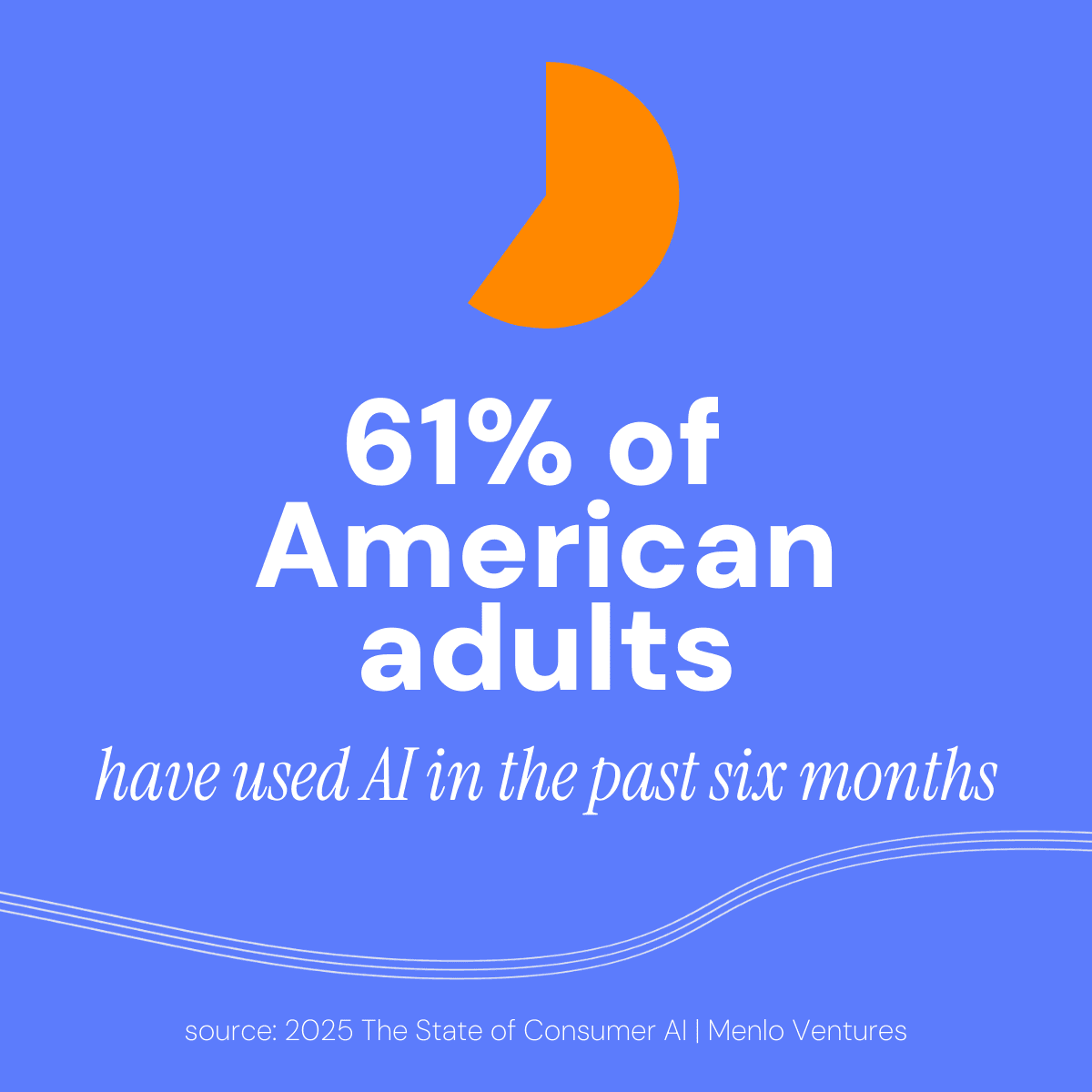
According to a study by Menlo Ventures, 61% of American adults have used AI in the past six months and nearly one in five rely on it every day. Globally, about 1.7–1.8 billion people have used AI tools, with 500–600 million engaging daily. While those sound like really big numbers, the reality is that this is just the tip of the spear.
Companies like OpenAI or Anthropic have quickly become a sort of silent daily infrastructure: where millions of us begin our thinking, planning, writing and decision making. Not a gadget, not a social network, but an invisible layer that now sits at the front door of our workflows. AI didn’t show up as the thing we use after we start working. It became the place we start.
And yet…even with this newfound reflex, there’s still massive whitespace.
It reminds me of the late 2000s/early 2010s, when Google was already the backbone of the internet, yet that didn’t stop social networks from emerging as entirely new layers of human behavior. Search didn’t eliminate opportunity; it created the foundation for new categories.
We’re in that moment again.
When I look at companies like Extra (Naveen Gavini’s latest project) what strikes me isn’t the feature set. It’s the category shift. Extra hints at a world where everyday communication becomes adaptive, contextual and deeply personal. Where tools that don’t just help you “do email better” but actually reshape the experience of how you connect and collaborate.
It’s not a feed. It’s not a chat app. It’s something closer to the first atomic unit of a new kind of social infrastructure ➡️ one that responds to how we think and how we want to show up.
The consumer AI moment isn’t missing.
It’s just unfinished.
The foundation is here and the next chapter is still wide open.
Quick Takeaway: What This Trend is Revealing
This trend shows that we’re entering an era where AI becomes the new “home screen” aka the starting point for daily behavior. Leaders should expect consumers (and employees) to demand tools that feel intuitive, contextual and emotionally aware. The whitespace is no longer in utility but in experience design: new categories will emerge around how people want to think, collaborate and express themselves, not just how they complete tasks.

2. The Great Paradigm Blur: B2C ↔ B2B + E-commerce Rewrites Itself
One of the most fascinating patterns of the past few years is how fluid the boundaries between consumer, team and enterprise have become. Tools that look like consumer apps are winning inside companies. Enterprise workflows are seeping into creator ecosystems. This has been happening for a few years, but I’m deeply convinced that the companies that will win in the future need to navigate both motions as a single wave.
And e-commerce, once a clean, linear funnel, is dissolving into something far more narrative-driven ➡️ it’s being powered by individuals, rather than brands.
You can see it in the way creators are shaping shopping behavior. You can see it in the rise of platforms like Daydream AI, or the pop ups from Chat GPT offering to handle your holiday shopping. You can see it in the conversations I’ve had with Jeremy Jankowski (CRO at EE72), who has a front-row seat to the collision of creators, commerce, and community. And you can feel it in the experiments people like Daydream are running at the edges of social and marketplace design.
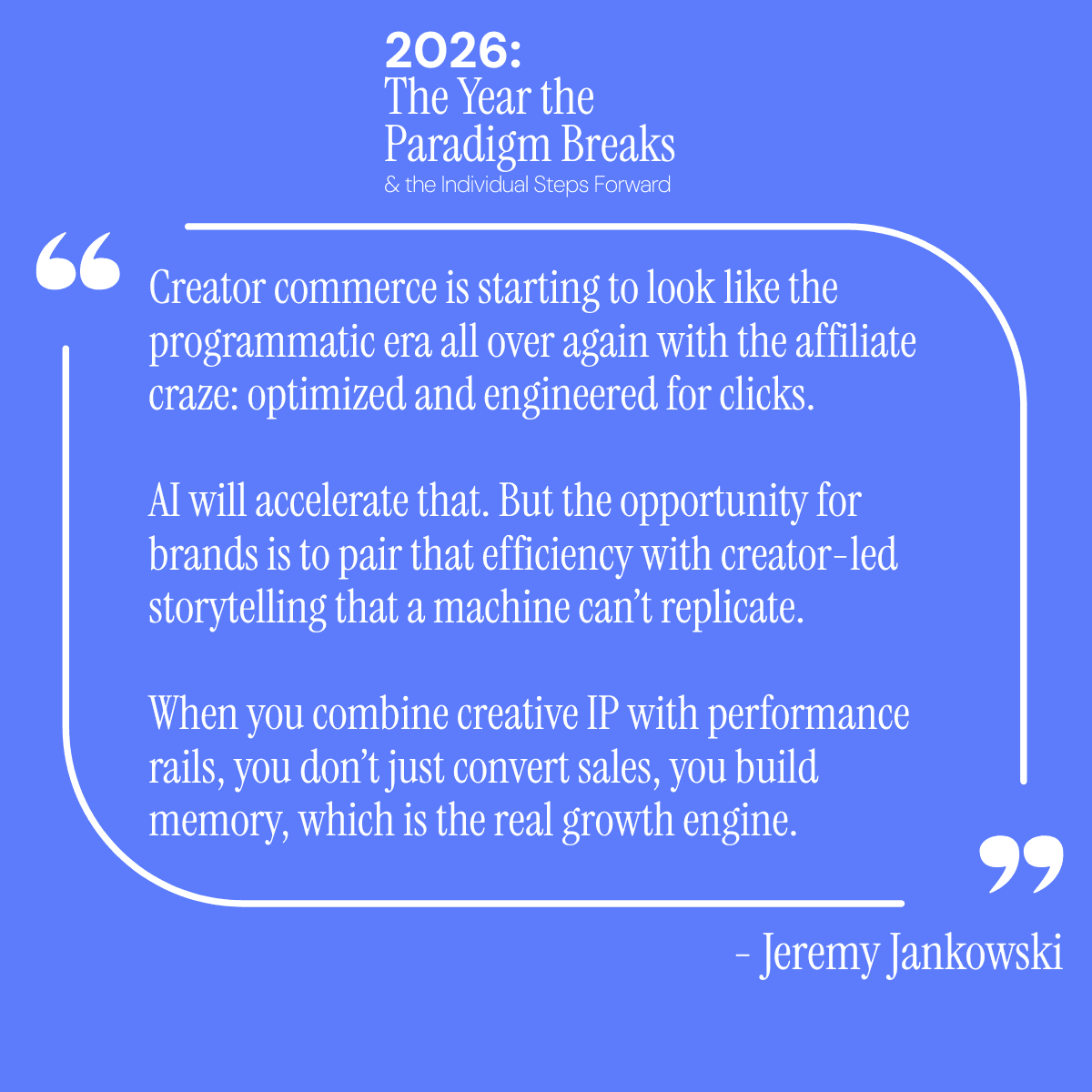
The next decade won’t be B2C or B2B. It’ll be both, at once — products that feel deeply personal but unlock enterprise-scale value. And e-commerce will stop being a checkout button. It’ll become a story you enter, shaped by the voices you trust.
This is the year the walls fall down.
Quick Takeaway: How This Reshapes Teams & Product Strategy
This trend shows that companies can no longer afford to operate consumer and enterprise motions in separate lanes: The winners will be fluent in both. Leaders will need to design products that serve individuals with consumer-grade simplicity and teams with enterprise-grade depth. And for brands, this is a call to rethink growth: performance alone won’t cut it, so the future belongs to those who pair AI-powered efficiency with creator-powered storytelling that builds memory, trust and emotional resonance.

Work is being rewritten from the inside out. The traditional boundaries that once defined careers (roles, functions, ladders, titles) are dissolving. The past two years have flattened the baseline of competence, and what’s rising are the human differentiators: range, adaptability, taste, curiosity and the ability to reinvent oneself in real time. The next decade of work won’t be shaped by job descriptions; it will be shaped by the people who know how to stretch beyond them.
3. The Rise of the Unicorn Hire 2.0
The “unicorn hire” used to be about pedigree, ex: the Stanford degree, the FAANG tour, the perfect LinkedIn arc. That era is over. Today’s unicorns are something else entirely: part operator, part creator, part strategist, part technologist, and surprisingly often… part translator.
AI has flattened the baseline of competence, so differentiation now comes from adaptability, taste and the ability to learn in public. When I talk to founders about who they’re hiring, I hear the same line over and over: “I need someone who can do the work, see around corners, and shape the work.”
Today’s best talent carries range. They can write, think visually, model systems, manage ambiguity and ask questions with curiosity. They aren’t intimidated by tools; they aren’t dependent on them either.
I loved Mallory Contois’s (Founder at Old Girls Club and VP Growth at Maven) quote on a recent LinkedIn Post: You should be plotting your path toward specialized generalist or generalized specialist.

While 2025 was a year where hiring shifted towards specialized talent (particularly in engineering), in 2026 companies are looking for talent that can thrive in ambiguous spaces and learn what is next.
Another person with great takes on the topic is Anna Mack: If, like me, you’re walking down an unconventional path, then society might believe that you’re failing, faltering or floundering. But I see things differently. I see someone who recognizes that the world is changing and that you must change along with it. I see someone who is bravely pivoting, portfolio-ing, pursuing and plunging headfirst into a future of work even while others pass judgement from behind.
Unicorn hires are no longer defined by what they know. They’re defined by their elasticity; their ability to expand, contract, and reinvent themselves as the work demands.
Quick Takeaway: What This Trend Means for Leaders & Talent
This trend shows that hiring is shifting from experience-based to capacity-based decisions. Leaders will need to look beyond linear resumes and source for adaptability, curiosity and range. For individuals, the path forward is to cultivate elasticity: to build a personal portfolio of skills that can stretch with the work, not break when the work changes.
If you are the talent, it’s time to be intentional. If you are the hiring manager: hire for potential and eagerness to learn (fast).
4. Work Identity Breaks Open: Roles Blur Into Hybrids
For the past decade, we’ve talked about “cross-functional teams.” But 2026 is the year cross-functional becomes…personal. The boundaries between product, engineering, design, content and strategy are collapsing, but not because companies want them to, simply because the most interesting work can no longer be done inside tidy job descriptions.
I’m seeing product managers who build/write their own prototypes. Designers who run their own experiments. Engineers shaping narratives. Creators thinking like operators. People becoming portfolios instead of roles.
People like Claire Vo, Product leader and host of How I AI, have been preaching this for a couple of years now, but 2026 will be the year when these new structures crystalize.
This shift isn’t just structural, it’s psychological. Many of us were trained to believe our identity came from our function. Now, identity is fluid. Hybrid. Adaptive. Multi-threaded. Work is becoming a space where people bring their full range: their analytical side, their creative side, their leadership instincts, their curiosities.
Roles are becoming more porous, and in that porosity, something much more human is emerging: range as a way of being.
In moments of transition, the most reliable compass isn’t a ladder or a job description, it’s the quiet pull of your own curiosity. Career growth starts to look less like following a path and more like following the tug: the idea you can’t shake, the skill you keep circling back to, the part of someone else’s job that secretly excites you. Those small signals are invitations. They reveal the edges of your range, the places you’re meant to stretch into next. And if you pay attention to them, you often end up discovering a version of your work identity that feels more expansive, more energizing and far more your own.
Quick Takeaway: How This Changes Careers & Teams
This trend reveals that static roles are losing relevance; what matters is your ability to move fluidly across domains. Leaders should create environments where experimentation is expected and identity can stretch without penalty. For individuals, the invitation is to treat your career less like a ladder and more like an evolving portfolio, something to be shaped by curiosity, not convention.

Capital is reorganizing itself. After years of hype cycles and decision-making driven by consensus, we’re entering a phase where conviction matters more than capital size, boldness is king and a balance of experience and ingenuity matters more than abstractions. The people shaping the next wave of early-stage investing aren’t necessarily the ones with the biggest funds, but the ones closest to the craft of building. These trends capture how capital is becoming more personal, more grounded and more aligned with the realities of building in an AI-first era.
5. Operators Become the New Power Investors
For years, venture has gone through cycles — different styles, philosophies and kinds of expertise rising to the surface. But one of the most energizing shifts happening right now is the rise of operator–investors: people who have built, led, scaled and rebuilt companies…and are now using that lived experience to support the next generation of founders.
What I love most is how grounded this group tends to be. They understand the real pinch points: the messy middle, the moments where growth feels nonlinear, the nuances of hiring, the bets that feel uncomfortable until they’re suddenly obvious. There’s a different kind of empathy that comes from having been inside the problem.
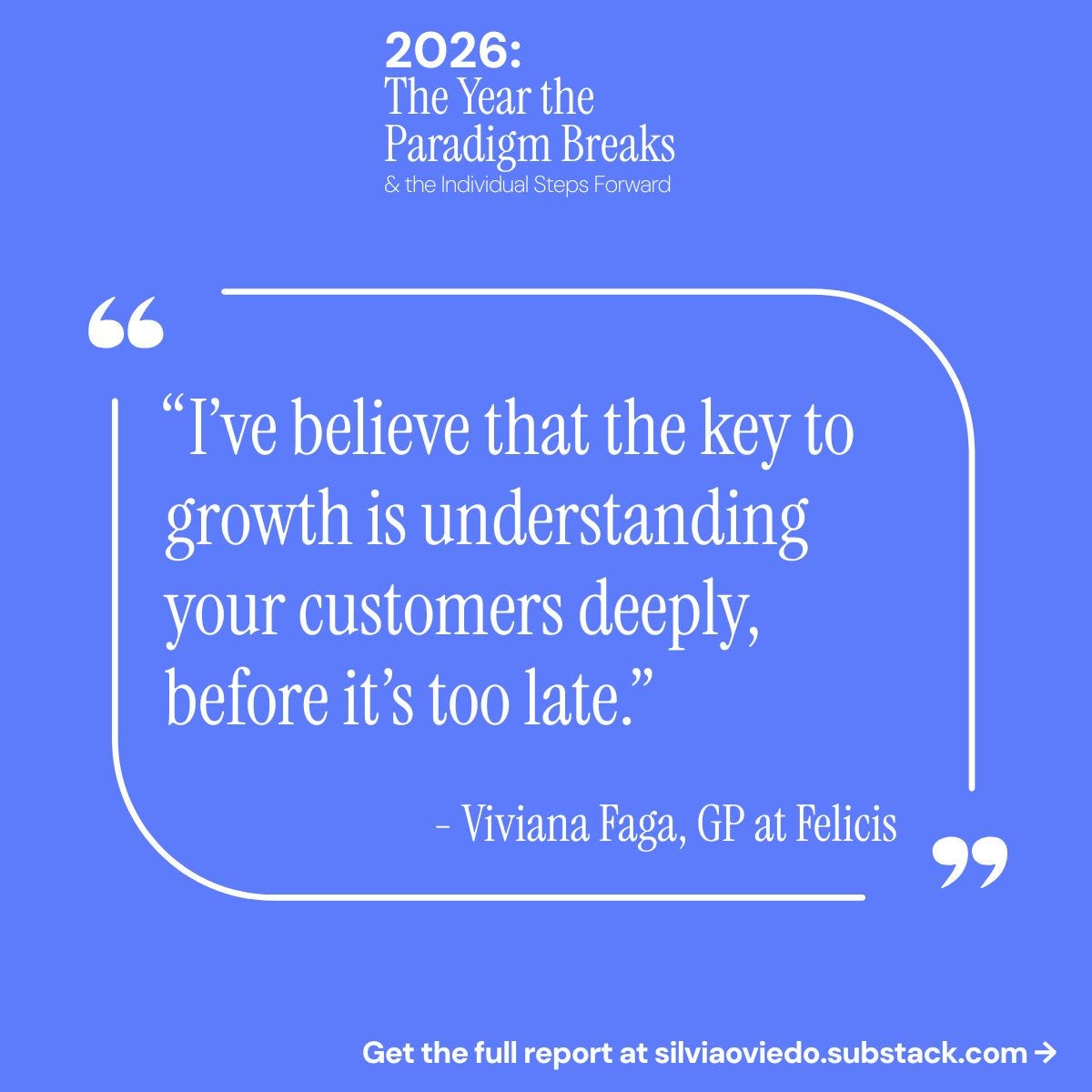
Viviana Faga, GP at Felicis, put words to something I’ve observed across this new wave of operator–investors: “I’ve believe that the key to growth is understanding your customers deeply, before it’s too late.” You can feel the operator in that sentence — the focus on reality, not theory.
And honestly, there are so many people doing fascinating things in this space right now. People backing companies with conviction, showing up with real pattern recognition, and building communities around their expertise. It feels like early-stage investing is entering a new chapter, one where craft and experience and generosity play an even bigger role.
The VCs that are going to run away with it are dreamers with people skills. Community builders who can move energy, not just capital. - Aydin Senkut, Founder at Felicis
It’s less about categories and more about momentum. And the momentum is definitely here.
Quick Takeaway: What This Trend is Revealing
This trend shows that early-stage founders will increasingly choose investors who understand their world from the inside, not just from a theoretical angle. Leaders should expect more hands-on, experience-driven support and more emphasis on customer obsession, not vanity metrics. For operators considering the jump into investing, this is a moment of opportunity: your lived experience is becoming the most valuable currency in early-stage capital.
6. The Microfund Renaissance: Small Checks, Big Conviction… Paired with massive bets.
The rise of tiny funds, i.e. solo GPs, micro-angels, small syndicates, is one of the most delightful democratizing shifts in tech. It’s no longer unusual to see someone with six figures under management making sharper, bolder bets than a traditional fund with hundreds of millions. (Side note: the pre-seed and seed world is wild at the moment, so it’s quite interesting and exciting to see this seemingly opposing trend emerging).
Why? Because microfunds operate from conviction, not consensus.
They back the weird ideas. The overlooked founders. The people who don’t fit the archetype but have something electric in their thinking. They use AI to do due diligence at a scale that was impossible before. They deploy quickly. They build communities that become distribution engines.
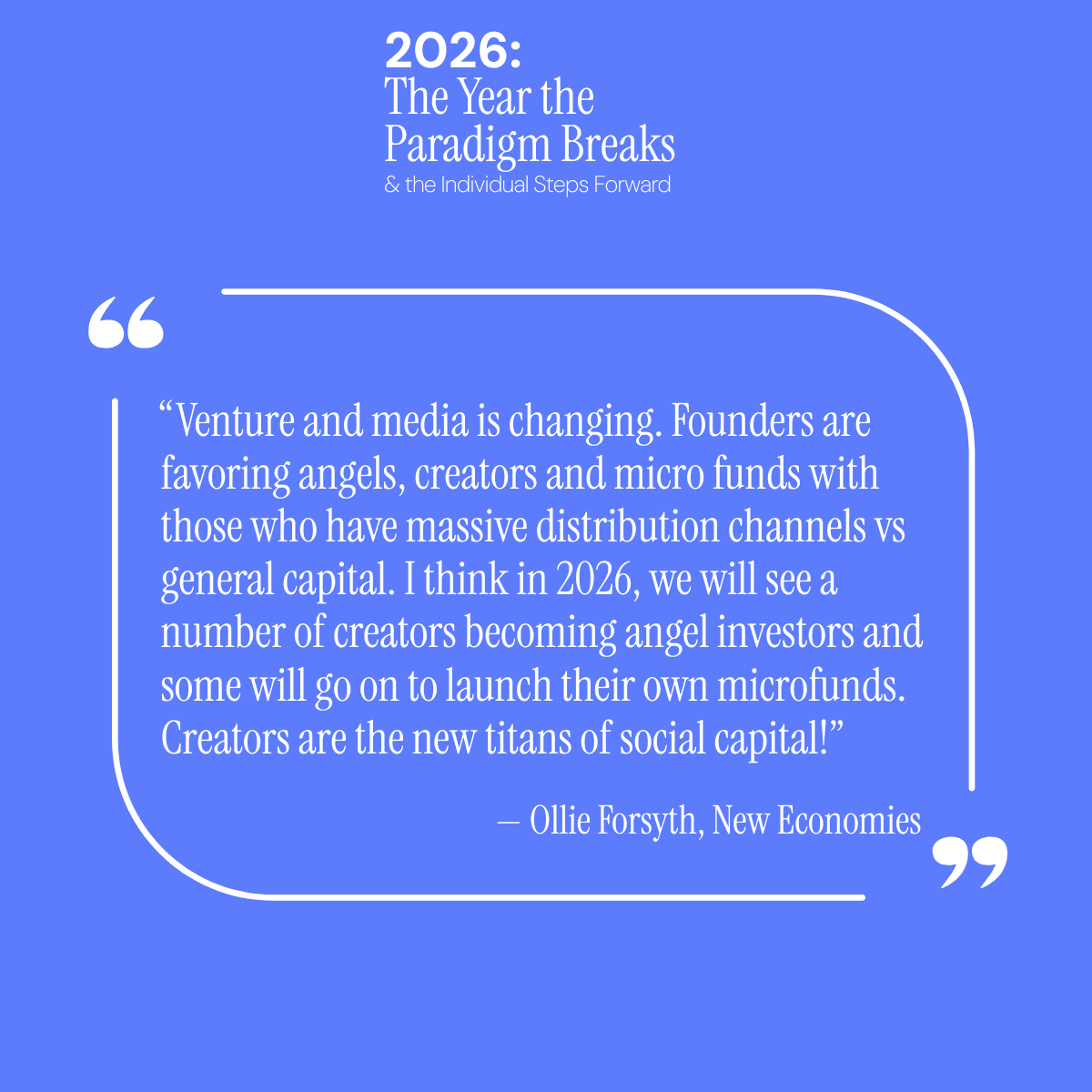
In a way, microfunds are the investment equivalent of hybrid roles: flexible, creative, fast-learning, independent. They’re shaping the next generation of companies more than most people realize. And thought leaders in the space, like Ollie Forsyth of New Economies, are taking notice, “Venture and media is changing. Founders are favoring angels, creators and micro funds with those who have massive distribution channels vs general capital. I think in 2026, we will see a number of creators becoming angel investors and some will go on to launch their own microfunds. Creators are the new titans of social capital!”
In parallel, big funds are shifting to possibilities, not just guaranteed outcomes. While sometimes bold and risky, these moves are the ones that shaped the internet as we know it: big, tectonic shifts that feel like true leaps into what could be.
Quick Takeaway: How This Changes The Founder–Investor Dynamic
This trend reveals a shift toward a more open, democratized capital ecosystem: one where access, speed and conviction matter more than size. Founders should expect more specialized, values-aligned investors who move quickly and believe early. And for leaders inside companies, microfunds signal a broader cultural trend: the rise of small, focused, highly motivated groups outperforming larger, slower-moving institutions. I’m personally excited about the doors this will open for many folks writing their first checks!
Join me back here tomorrow, where I’ll be sharing Part 2 of the 2026 Trend Report and be sure to save this post, share it with a friend or comment your own predictions.