
Clarity
2026 Trend Report: Part Two
Silvia Oviedo López
Co-Founder & CEO
,
Blomma
8
min read
Welcome to Part 2 of our 2026 Trend Report. As I mentioned yesterday, 2026 feels like an inflection point; a break in the old paradigm. We're about to experience a shift in where the power lies.
We're reinventing roles. Reinventing creativity. Reinventing leadership. Reinventing how companies operate. Reinventing what "expertise" means.
And most importantly, we're reinventing what it means to be an individual with agency in a world that suddenly feels fluid, uncertain and full of possibility.
Below I'm sharing the final six of the twelve shifts I've been watching most closely as we head into 2026. Part predictions, part patterns. The kind that shape a year before the year knows what it's becoming.
Let's dive in.
Culture is rebuilding itself from the inside out. After a decade defined by scale, speed and social algorithms, people are craving depth again: depth in expertise, depth in communities, depth in connection and depth in creativity. AI has accelerated the shift: when the baseline becomes automated, what rises to the top are the distinctly human layers of craft, taste and shared knowledge. These next two trends capture how culture is reorganizing itself through fluency and intentionality.
7. Expert Networks Become the New Infrastructure Layer
One of the biggest shifts of 2026 is the quiet exodus from traditional social networks into expert networks. And it's not about followers, it's about fluency. People are tired of performative spaces where the loudest voice wins and the signal gets drowned by the scroll. What they want now is depth. Shared vocabulary. Real craft. Places where you don't have to explain the basics because everyone already speaks the same language.
I've had conversations with Casey Winters, cofounder of SuperMe, a platform where you can literally download your expertise and make it accessible to others, and with Vikram Bhaskaran, founder of Roon, an AI-augmented expertise network for doctors. They're building in completely different domains, yet the same idea keeps surfacing: people don't just want information; they want expertise, they want authenticity and they want it in a container that respects the weight of both.
Because right now, there's a massive arbitrage on expertise. The platforms we've been using for the last decade (X, Instagram, LinkedIn, even Threads) are incredible for distribution, but they're structurally hostile to nuance. They reward speed, not accuracy. Personality, not craft. Opinions, not knowledge.
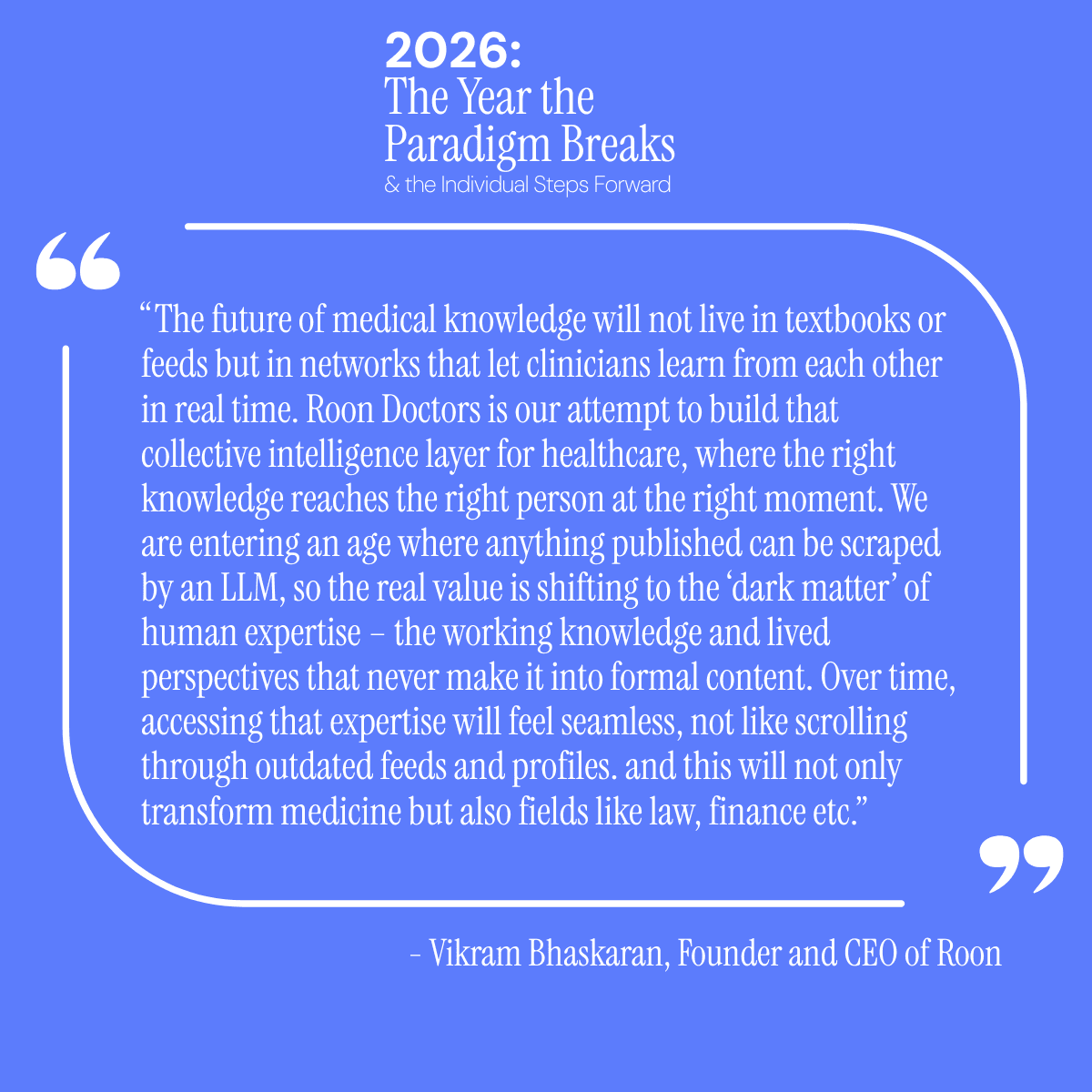
"The future of medical knowledge will not live in textbooks or feeds but in networks that let clinicians learn from each other in real time. Roon Doctors is our attempt to build that collective intelligence layer for healthcare, where the right knowledge reaches the right person at the right moment. We are entering an age where anything published can be scraped by an LLM, so the real value is shifting to the ‘dark matter’ of human expertise – the working knowledge and lived perspectives that never make it into formal content. Over time, accessing that expertise will feel seamless, not like scrolling through outdated feeds and profiles. and this will not only transform medicine but also fields like law, finance etc." — Vikram Bhaskaran, Founder and CEO of Roon
These expert networks are quietly becoming the infrastructure layer underneath modern careers, making them an interesting overlay to this trend on top of the vertical market opportunity that is being created.
Quick Takeaway: This trend tells us that the future of learning won't happen on feeds; it will happen inside rooms (physical and virtual) where people share a common craft. Leaders and teams should rethink where they go for answers, inspiration and hiring. The smartest organizations will plug into expert networks not as "extras," but as strategic infrastructure.
8. The Return of the Craft-Forward Creator
The creator economy is not dying. It's maturing and sharpening. For years, creators were told to optimize for volume: post more, ship faster, stay in the algorithm's good graces. But AI changed the dynamics. It raised the floor so dramatically that the ceiling had to move. Suddenly everyone can produce "content," so the thing that stands out now is craft. Taste. Discernment. A point of view you can't fake.
While AI has turned volume into a commodity, craft is the new scarcity. And the creators who lean into their artistic instincts — their intuition, their aesthetic sensibility, their voice — will define the next era of culture. Not because they post more, but because they create with intention.
Quick Takeaway: Brands and leaders will increasingly look to creators not for output, but for taste. The creators who thrive will be the ones who treat their work like creative direction, not content production.
Leadership used to be defined by decisiveness, visibility and the ability to move fast. But in 2026, the center of gravity is shifting. We're entering a moment where leadership is no longer about having the answers; it's about creating the conditions for clarity, steadiness and psychological spaciousness in a world that feels increasingly unstable.
9. Coaching Becomes a Daily Ritual for Resilience
There's a shift happening inside organizations: people are starting to build small rituals around reflection, clarity, and self-direction. Not because HR gave them a framework, but because survival in this environment requires it.
Coaching is no longer a luxury for executives. It's becoming a daily micro-practice: thinking about how you think. Noticing the patterns. Naming the tradeoffs. Asking better questions. Pausing before reacting.
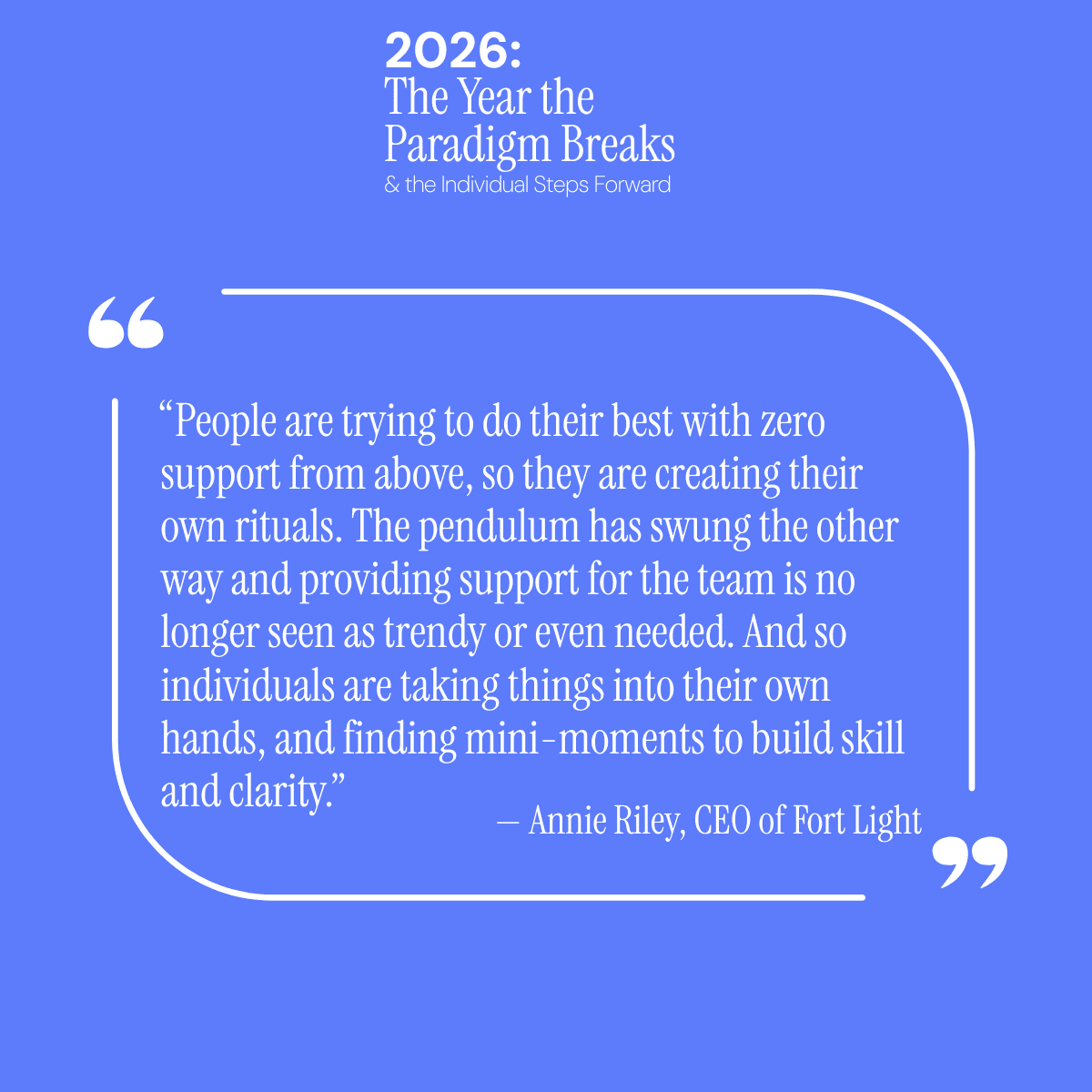
As Annie Riley puts it: "People are trying to do their best with zero support from above, so they are creating their own rituals. The pendulum has swung the other way and providing support for the team is no longer seen as trendy or even needed. And so individuals are taking things into their own hands, and finding mini-moments to build skill and clarity."
Coaching is turning into a resilience practice: a way for individuals to anchor themselves in a world that keeps shifting.
Quick Takeaway: Growth is becoming decentralized — people aren't waiting for annual feedback cycles anymore. Leaders should expect their teams to crave autonomy, clarity and tools that help them think better, not just work faster.
10. The Human Leader in the Emotional Recession
We're living through an emotional recession. Not a recession of productivity or output, but a recession of clarity, grounding and psychological steadiness. Most people aren't burnt out from doing too much. They're burnt out from holding too much.
This is why leadership matters more than ever. The leaders who make a difference aren't the ones hosting the loudest all-hands or issuing the boldest proclamations. They're the ones who create emotional coherence. Leaders who communicate simply, even when the situation isn't simple. Leaders who take the time to think before making irreversible decisions. Leaders who consider not just the financial impact, but the psychological one.
The future won't reward the loudest leader or the most charismatic one. It will reward the leader who can create safety in motion. Lead with clarity within uncertainty, direction within ambiguity, spaciousness within accelerated change.
Quick Takeaway: Psychological safety is becoming a strategic advantage. Leaders who develop the capacity to steady themselves (and their teams) will unlock healthier cultures, clearer thinking and faster execution.
We've spent the last few years debating what AI can do. But what's becoming clear in 2026 is that the real shift isn't about efficiency at all. It's about architecture. We're entering a moment where intelligence becomes a layer and our systems, our teams, even our own ways of thinking have to evolve to meet it.
11. The AI-Native Operating Model Arrives
One of the most important shifts of 2026 is that companies are finally redesigning how they operate — not by slapping AI onto old workflows, but by rebuilding workflows from scratch for a world where humans and machines collaborate.
AI-native teams don't treat AI as a tool; they treat it as an operating system. They redesign processes around cycles of exploration and refinement. They eliminate half the meetings. They reduce the administrative load. They measure progress differently: not by hours, but by insight, speed, and quality.
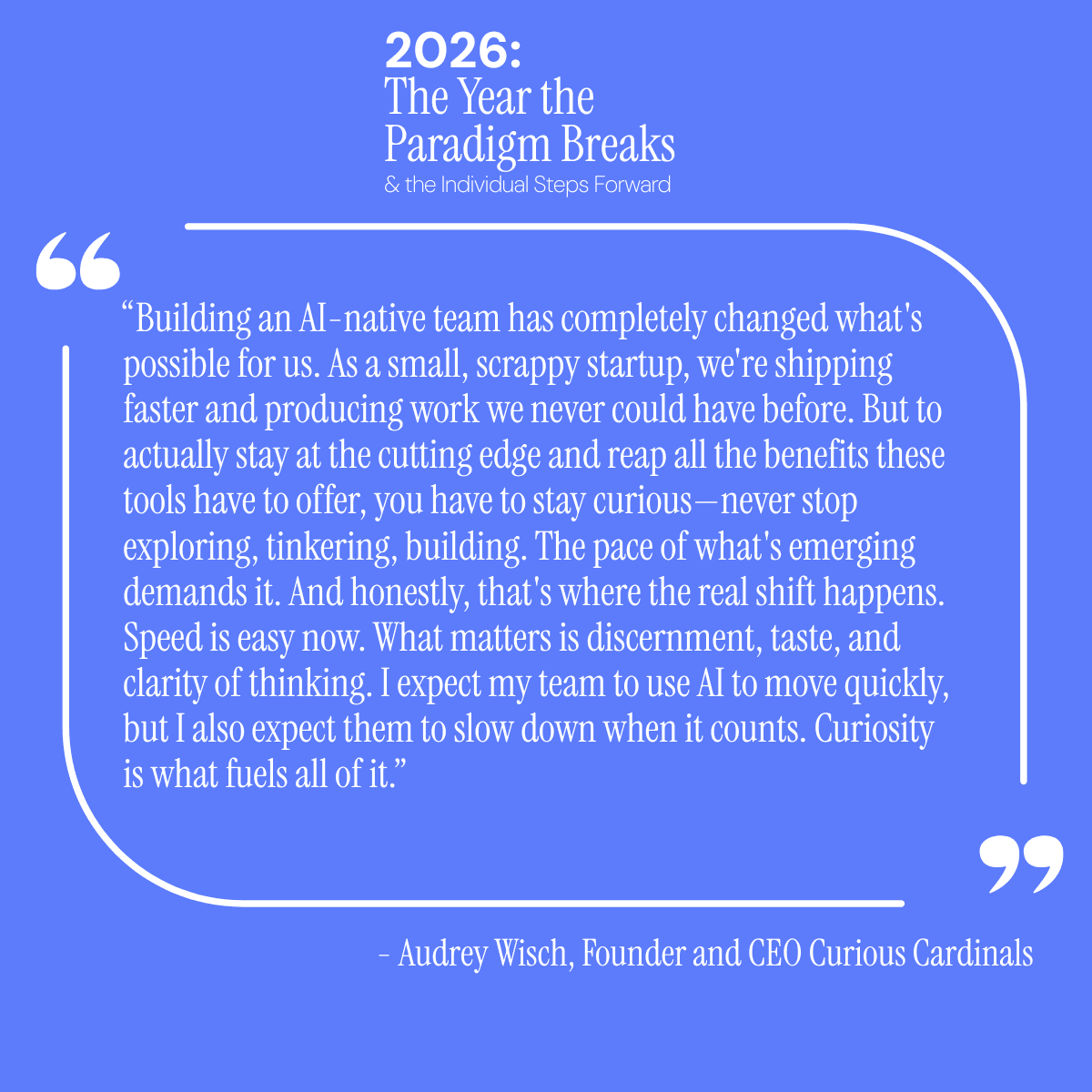
"Building an AI-native team has completely changed what's possible for us. As a small, scrappy startup, we're shipping faster and producing work we never could have before. But to actually stay at the cutting edge and reap all the benefits these tools have to offer, you have to stay curious—never stop exploring, tinkering, building. The pace of what's emerging demands it. And honestly, that's where the real shift happens. Speed is easy now. What matters is discernment, taste, and clarity of thinking." — Audrey Wisch, Founder and CEO Curious Cardinals
Quick Takeaway: Leaders can't keep retrofitting AI onto old ways of working. If the system is broken, AI will only accelerate the dysfunction. Teams that pause, simplify and rebuild their operating models from zero will unlock exponential speed and clarity.
12. The Thinking Tools Era Begins
If 2023–2025 were about "AI that does tasks," 2026 is about "AI that helps us think." Tools that don't just generate output but generate clarity. Tools that help us set priorities, challenge assumptions, model decisions, see blind spots and ultimately help us leap forward in our abilities.
This is the shift I find most exciting. AI is no longer the thing replacing human thought: it's becoming the thing that deepens it. A thinking partner. A reflection engine.
And if I'm going back to our first trend – the "Big Consumer AI Moment" – this is where I'd look to find the most opportunity. Focusing on how to connect with consumers without trying to replace them, and rather manifest as a partner alongside what they're working to build or create.
Because the next big consumer AI moment won't be rooted in productivity. It will be rooted in self-understanding.
Quick Takeaway: Leaders and teams will need to become fluent not just in using AI, but in thinking with it. The organizations that thrive will be the ones that treat reflection as a strategic muscle.
When I pull back and look at these twelve shifts, a single theme emerges:
The center of gravity is moving back to the individual.
Not in a hyper-individualistic way → but in a way that restores agency.
You are no longer defined by your role. Your creativity is no longer limited by your tools. Your career is no longer confined to one lane. Your growth is no longer dependent on corporate timing. Your ability to think clearly is now a competitive advantage.
We're living through a reinvention of work, identity, leadership, creativity and intelligence. The most powerful thing you can do in 2026 is embrace your own elasticity. Learn. Adapt. Create. Reflect. Collaborate. Question. Stretch.
Paradigms are breaking. Old structures are dissolving. And in the clearing that's left, something very human is emerging.
This year belongs to the people courageous enough to reinvent themselves.
Thank you for reading! Would love to hear your take on these predictions, and any other patterns you're seeing!