
Growth
Anthropic Surveyed 81k People About AI.
Silvia Oviedo López
Co-Founder & CEO
,
Blomma
5
min read
Anthropic recently released findings from one of the largest qualitative studies on how people use AI. Over 81,000+ people participated — real conversations, across varying industries, at a global scale.
Buried inside a report about productivity and automation is something that really stuck with me.
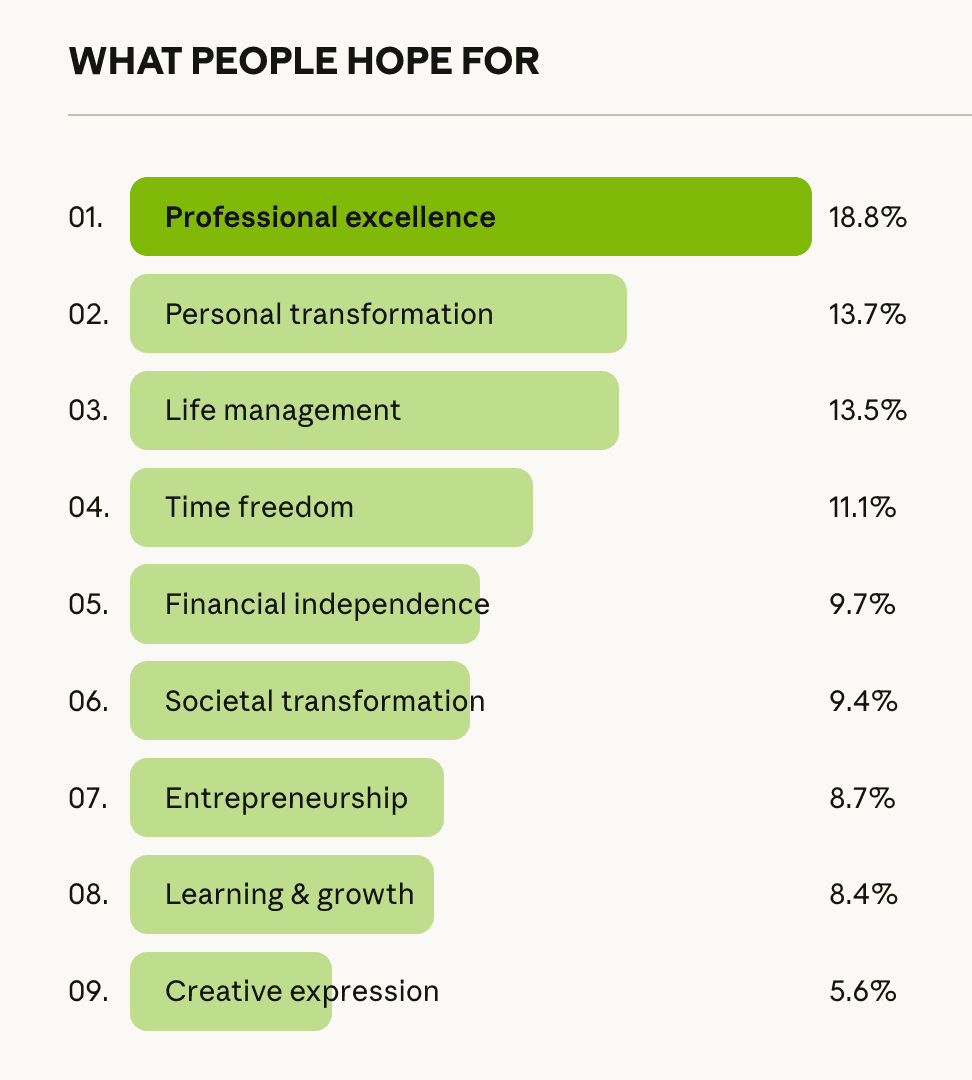
When researchers asked people what they really hoped from AI (not the surface answer, but the one underneath it) the productivity talk fell away.
The largest single group, 18.8%, said they wanted AI to support their professional excellence. Another 13% wanted something more personal: to actually grow as a human being. To feel better. To become someone they were excited to show up in the world as.
This was surprising, but also it wasn't.
The traditional career ladder was designed for a different world: You put in the hours, you climbed the steps, you collected the titles. The system rewarded endurance and loyalty. It was never designed around the question: who are you becoming?
And yet, that's the question people are bringing to their AI tools at 11pm. Not "help me draft this memo." But: help me think through whether I'm on the right path. Help me figure out what I actually want. Help me become better at the parts of my life that matter.
The system doesn't have a process for that. Most HR teams don't have a framework for it. Many managers won't have the bandwidth, training, or permission to go there with their teams.
So people are turning to the closest thing available.
But here's the gap the study also surfaces:
Trust is fragile. AI tools in their current state are still falling short. Respondents described being "burned by its mistakes" in the same breath as being impressed by its judgment. They find genuine solace in an AI-assisted reflection only to then worry about what it means to outsource their inner life to a tool.
The benefits, notably, are not evenly distributed. Independent workers — entrepreneurs, freelancers, people with side projects — are three times more likely to report real economic gains from AI than institutional employees. The people inside the system they believe they're most secure in are benefiting the least from the tools that were supposed to help them.
That asymmetry isn't an accident. Institutional structures aren't built to support the kind of fluid, self-directed growth that actually changes someone's trajectory. They're built to sustain the institution.
And here's the question I keep coming back to:
What if there was a system — an actual, intentional system — designed specifically to support personal and professional growth? Not a once-a-year review. A real infrastructure for becoming.
It would need to meet people where the real questions live. Not just "what are your goals for this quarter" but "what kind of work makes you feel like yourself?" It would need to hold long-term context, so it could reflect patterns back to you that you can't see from inside your own story.
In short, it would need to do what the ladder never could: treat the person as the point.
Eighty-one thousand people, speaking in their own words, about what they most want from the most powerful technology of our generation. And so many of them are essentially saying: I want help becoming who I'm trying to become. I just haven't found anything I trust enough to help me get there.
The next question — and the one I'm spending most of my time on — is: What do we build in response to that?