
Growth
How Do You Know When It's Time to Bet on Yourself?

Silvia Oviedo López
Co-Founder & CEO
,
Blomma
6
min read
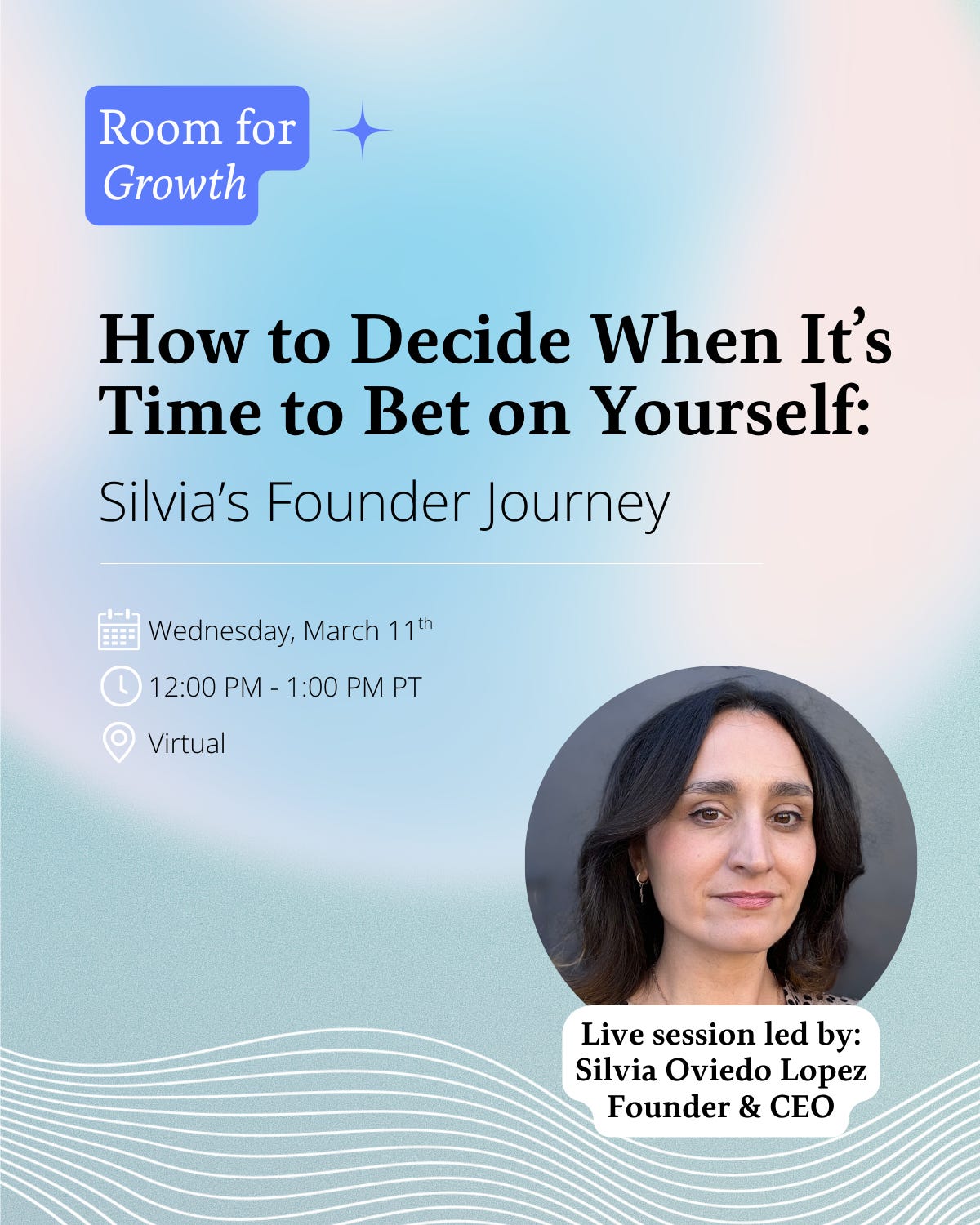
I'm hosting a Room For Growth virtual session on March 11th on a theme that keeps coming up in my recent conversations: How do you know when it's time to bet on yourself?
It's one of the hardest growth questions many people face. And here's the thing: I don't think you ever "just know."
I think you notice.
You notice the question resurfacing, your patience thinning. What used to feel tolerable now feels expensive. That's usually where it starts.
The First Signal: When Staying Started to Cost More Than Leaving
When I first decided to make a move, I was in a role that I loved — and it also looked good on paper. Yet internally something had shifted. I wasn't learning at the edge of my ability anymore. I could do the job. I just no longer felt like I could grow in it.
The signal wasn't misery. It was stagnation.
What I listened to:
The fact that my curiosity had lost its signal.
The subtle resentment creeping in when it felt like I wasn't pursuing my purpose.
The envy I felt watching founders build things from zero.
What I deliberately ignored:
The external validation of "you'd be crazy to leave."
The prestige math.
The narrative that I should stay until I felt 100% ready.
I didn't feel ready. I felt restless.
To de-risk the decision, I got specific. I ran the numbers. I mapped worst-case scenarios. I asked myself, If this fails, what's actually true about me? Would I still be employable? Yes. Would I regret not trying? Almost certainly.
The Second Signal: When the Question Wouldn't Go Away
The second decision wasn't about leaving a job. It was about expanding into something bigger than I had originally envisioned.
Here's what "knowing" felt like: a quiet persistence. The idea didn't fade when I got busy. It followed me into the shower. Onto flights. Into notebooks.
That's a signal I trust now → When something keeps asking for my attention long after I've tried to ignore it.
To de-risk that move, I tested before declaring. I wrote small pieces before building a platform. I had early conversations privately before speaking publicly.
What surprised me was how much clarity comes after you step forward, not before. Action sharpened the thinking. Not the other way around.
The Third Signal: When Fear and Excitement Lived Side by Side
The fear was louder. But so was the pull.
I've learned that the presence of fear isn't disqualifying. The question is: what kind of fear is it?
I didn't try to eliminate fear. I tried to make the risk legible:
What are the variables I can control?
What timeline am I actually committing to?
What evidence do I already have that I can handle this?
Preparedness is often less about skills and more about self-trust. Have you seen yourself recover before? Have you built proof that you can navigate uncertainty?
So How Do You Know?
I don't think you wait for certainty. You look for patterns:
The question that won't quiet down.
The energy leak you can no longer justify.
The future version of yourself you keep imagining.
The friction that feels developmental, not destructive.
And then you ask harder questions:
Am I running toward something or just away from discomfort?
Do I want the work, or just the identity?
Have I done enough to understand the real risk?
Betting on yourself is not a leap. It's an audit.
Room for Growth is a small series for people navigating real responsibility at work, designed to create space for clarity, reflection, and practical growth. Join us: