
Growth
If the Career Ladder is Dead

Silvia Oviedo López
Co-Founder & CEO
,
Blomma
5
min read
Erin McGoff's idea of the "career garden" really resonated with me. It's one of those metaphors that lands because it gives shape to something many people already feel, even if they haven't been able to define it accordingly.
As she describes, work no longer moves in a clean, upward line. It branches. It loops. It asks for reinvention. It rewards experimentation. It demands a different relationship to uncertainty than the one many of us were taught to expect. Erin's piece names that shift with real clarity.
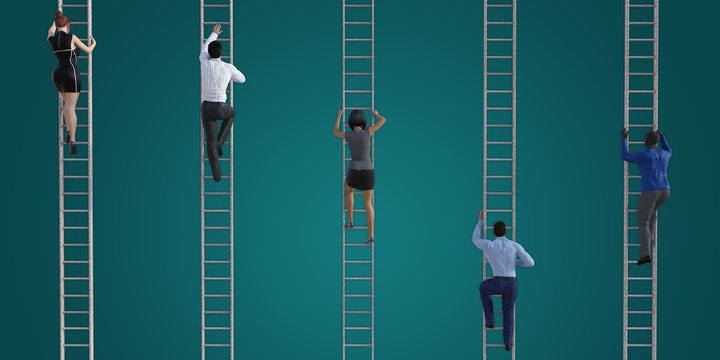
For a long time, the dominant promise of professional life was built around upward movement. Work hard. Stay focused. Earn the next title. Climb the corporate ladder. That model was never as universal or as fair as it pretended to be, but it did offer something powerful: legibility. You could tell where you were. You could point to what came next. Progress was visible, structured, and easy to explain.
A garden asks something else of us entirely.
A garden requires patience, judgment, attention, and care. It asks you to respond to changing conditions rather than assume that effort alone will produce the same result every season. Some things grow quickly. Some take much longer than expected. Some fail in ways that are painful and clarifying at the same time. Some need pruning before they can flourish. That feels much closer to the reality of work now, especially for people navigating careers shaped by constant technological change, blurred role boundaries, and a labor market that keeps rewriting its own rules.
What stayed with me most after reading Erin's piece, though, was not only the accuracy of the metaphor. It was the weight of what that metaphor implies.
Because a garden sounds beautiful. It also asks a great deal of the person tending it.
It asks for reflection, self-trust, language, discernment, resilience, and the ability to keep finding meaning while conditions keep changing around you. It asks people to narrate who they are while they are still becoming. It asks them to decide what to plant, what to let go of, what to invest in, and what to believe about themselves when there is no longer a neat external structure telling them whether they are on the right track.
And that's a profound shift.
For years, many institutions trained people for ladders. They built systems around titles, levels, milestones, and familiar definitions of success. Then the terrain changed. Skills began expiring faster. Roles became more fluid. AI accelerated the pace even further. And suddenly many people were expected to become more adaptable, more visible, more entrepreneurial, and more fluent in shaping their own story. Erin is right to name that reality.
But I think there is another truth sitting beside it: many people are not failing to adapt because they lack ambition. They are struggling because adaptation itself has become a form of labor, and often an invisible one.
It takes energy to keep recalibrating. It takes confidence to translate your experience into a changing market. It takes perspective to know which skill to build, which opportunity to pursue, and which version of growth is actually yours rather than simply the loudest one on the internet. It takes emotional steadiness to keep moving when there is less certainty, less structure, and less external reassurance than there used to be.
This is why I think the future of work is not only a story about adaptability. It is also a story about support.
If careers are becoming less linear and more self-directed, then the real question is not just whether people can grow. It is whether they have better ways to make sense of that growth while they are in it. Whether they have tools, language, and frameworks that help them reflect, decide, experiment, and move forward without feeling like they have to invent the whole process alone.
That feels especially important now, because so much of the conversation about the future of work still defaults to productivity. Faster. Smarter. More efficient. More output from fewer people. But careers are lived from the inside, and from the inside they are not only operational problems to solve. They are identity questions. Confidence questions. Direction questions. They shape how people understand their value, their momentum, and their place in the world.
That is one reason this conversation matters so much to me.
The career garden may be a useful metaphor for this era of work. But metaphors alone will not help people navigate it. Support will.
And we're building Blomma with the goal of providing that support.