
Reflection
Trend Report: The New Rules of Work in an Age of Uncertainty

Silvia Oviedo Lopez
CEO
,
Blomma
7
min read

I just spent two days at Fortune Brainstorm Tech surrounded by some of the sharpest leaders, investors, journalists and founders I know — people who spend a huge amount of time thinking about where things are heading. And the conversation that kept surfacing, in different rooms and different framings, wasn’t about technology. It was about people. About learning. About the growing gap between what work asks of us and what the structures around us actually provide.
I put together a trend report back in December, and thought it would be worthwhile to revisit what’s happening, what’s coming and what you should prepare for.
We are not simply watching work change. We are watching the social contract around work reorganize itself. The implied promise that shaped careers for decades: join a company, develop expertise, move steadily upward — is not just bending. In many places, it has already broken.
But here’s the thing about broken contracts: they also create space for new ones.
We are living in the age of doom and possibility, and the hardest, most urgent skill of the moment is learning how to hold both at once: avoid collapsing into the doom and avoid falling into the trap of toxic optimism (I am deeply an optimist, so the latter is sometimes hard). For right now, we should be ready to sit in the actual, complicated middle, and start designing the future.
We talk a lot about agents, but not enough about agency. I keep coming back to that.
Here are five things I believe are shaping how we work right now:
1. The Death of the Job (And the Rise of the Task)
The contrarian take: We’ve been arguing about whether AI will replace jobs. That’s the wrong question. Jobs aren’t disappearing. They’re dissolving.
For decades, the unit of work was the job. You got hired for a role, you did the role, and the role gave you a ladder. Now something more granular is happening: jobs are decomposing into atomic tasks. The summarizing. The drafting. The researching. The data cleanup. The first pass.
AI doesn’t take jobs wholesale. It pulls tasks out of them: the repetitive ones, the ones that used to take someone two hours and now take thirty seconds. It was interesting to hear Boris Cherny talk about his process to automate the places where he spends time every day. What’s left behind is a different job: one that requires judgment you can’t prompt, relationships you can’t automate, and decisions whose value comes precisely from being made by a human. (Caveat: I live in the world of knowledge worker, so please note that this comes with a fair bit of bias).
This matters more than it sounds. Because those entry-level tasks, the ones being pulled away first, weren’t just tasks. They were on-ramps. They were how people learned: note taking, drafting, being in the room, shadowing the senior person.
We have systematically automated away the training ground.
Companies now find themselves in an uncomfortable paradox: they want experienced employees, and they have dismantled the pathway through which people traditionally became experienced. You can’t harvest the crop when you’ve already removed the seeds.
People like Monica Abrams are taking this matter into their own hands: she’s built AI Snack Club, a community where thousands of women come together to share tips and tricks to level up in this AI-first world. She’s rapidly growing her footprint, with communities in several major US cities and members all over the world.
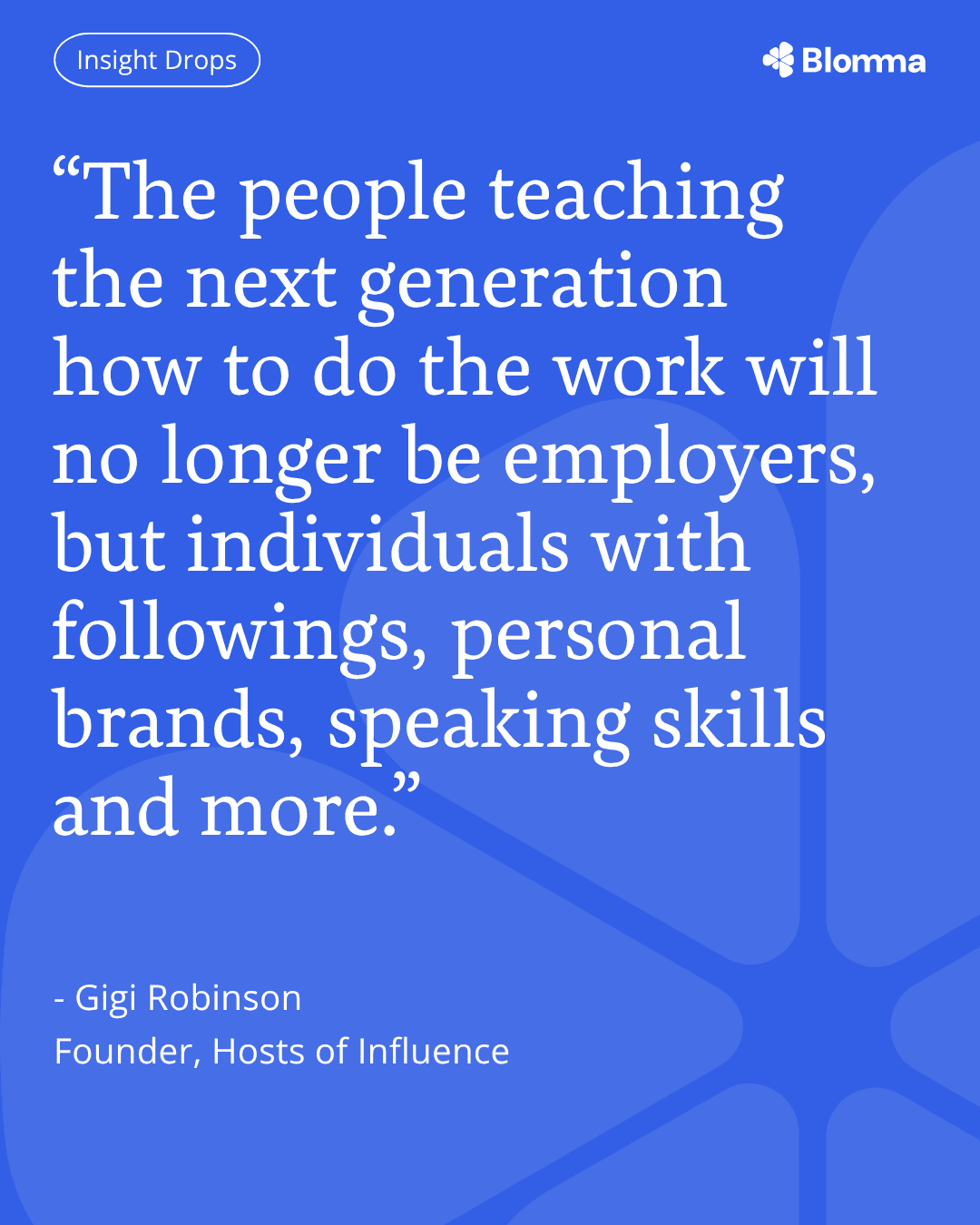
I also asked Gigi Robinson how she perceives this shift: she’s Gen Z, she’s an entrepreneur, has been deep in the creator economy for years, and she’s lived the shift of Creators AND AI. She has a different opinion: The people teaching the next generation how to do the work will no longer be employers, but are also individuals with followings, personal brands, speaking skills and more. That is the entire reason I built Hosts of Influence® and Creator Etiquette®. The professional development gap in the creator economy is the gap in the workforce, and the institutions that should be closing it are still pretending it is not there!
The question organizations haven’t asked yet: If the apprenticeship model no longer works by default, what are you building to replace it? Because if the answer is “nothing,” your talent pipeline has a hole in it you haven’t named yet.
What does this look like on the ground for you: are you seeing the apprenticeship gap widen in your organization? If you’re getting started in your career, how are things looking for you?
2. Stop Hiring for the Label. Start Hiring for the Loop.
The contrarian take: “Hire generalists” is the new “move fast and break things.” Sounds smart. Means almost nothing.
Everyone is saying it: the future belongs to generalists. Adaptable. Multidisciplinary. Fluid. It’s good advice with a bad frame, because it focuses on the label instead of the behavior underneath.
While I was at the conference, Jeremy Kahn asked for my thoughts on this topic. What actually makes so-called generalists effective right now isn’t breadth. It’s their learning loop. Their OODA loop — Observe, Orient, Decide, Act — the speed and appetite with which they take in new information, update their model of the world, and move. Generalists often have this behavior, which is why they’re performing. But specialists can have it too. And generalists without it are just scattered.
The hiring signal for this moment isn’t “has worked across multiple domains.” It’s “shows up to ambiguity with appetite instead of paralysis.” It’s the person who doesn’t wait to be fully certain before they begin. The person who treats being wrong as useful data.
Résumés don’t capture this. Interviews barely do. The people who thrive in this era will be distinguished less by what they know and more by how fast they can figure out what they don’t.
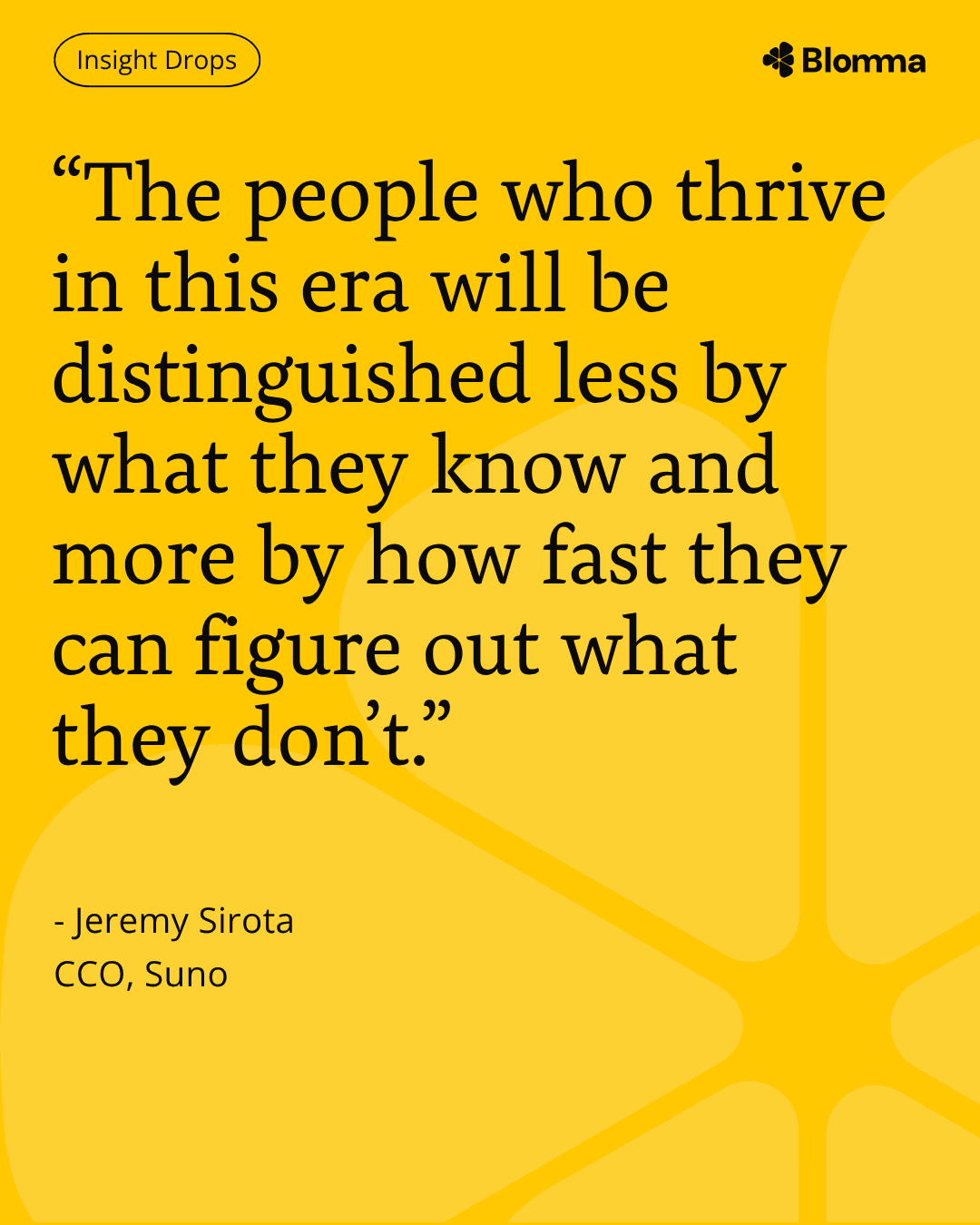
I chatted with Jeremy Sirota (who recently joined the leadership team at Suno) to get his take: The people who thrive in this era will be distinguished less by what they know and more by how fast they can figure out what they don’t. What they don’t know and how to learn it (or find the people to complement them)?
The truth for hiring managers: Most job descriptions are still written for the world as it was. They’re optimized for credentials, not for capacity. You are screening out the exact people you’re about to need.
What’s the best interview question you’ve found for detecting a fast learning loop? I’m collecting these.
3. The AI Adoption Gap Is Not a Technology Problem
The contrarian take: Most companies don’t have an AI problem. They have a structure problem dressed up as an AI problem.
Every company is becoming AI-first. Every workflow is up for reinvention. Every leader is experimenting.
And yet, talk to enough people leaders off the record, and a different story surfaces. Tools are proliferating. Dashboards are multiplying. Everyone is tired. And the gap between what AI can do and what organizations are actually capturing from it keeps widening.
The reason most AI transformations stall isn’t the technology. It’s that companies are trying to adapt new capabilities to old structures, and structures resist. You can give a team the most powerful tools ever built, and if the incentive structures, the org chart, the approval processes, and the culture haven’t moved, the tools will get used timidly, if at all. In parallel, you have to consider the fact that organizations oftentimes fail to acknolwedge employee fears of being replaced by the very thing they’re being asked to adapt to. This was a topic that kept coming up at roundtables that included folks like Chris Bedi, China Widener, Phil Wiser and Kristin Stoller.
Transformation that actually works requires breaking something. Not blowing up the company. But breaking enough structure that new behavior has room to emerge. The organizations getting actual returns from AI are not the ones who added AI to their existing workflows. They’re the ones who redesigned the workflow around what AI makes possible.
Companies winning right now are not asking “how do we use AI?” They are asking “what constraints does this technology remove?” That is a different question. It leads to a different place.
Knowledge is also concentrating in this gap. The asymmetry between organizations that are genuinely transforming and those performing transformation is widening — in capability, in speed, in competitive position. And the companies that focus on outcomes and not just process get a headstart. The gap compounds. It does not wait.
What is your take on this balance?
4. The Manager in the Middle Is Being Asked to Do the Impossible
The contrarian take: We keep talking about leadership development. What managers actually need right now is relief.
For much of the last decade, the conversation about management has been about training better managers. Better coaches. Better feedback-givers. More emotionally intelligent. More psychologically safe. Better at the hard conversation.
All of that is real and still important.
But something has shifted that the “better manager” conversation doesn’t fully address: the job itself has gotten structurally harder, while the infrastructure around it has gotten thinner (this is an interesting study).
Managers are now expected to be coaches, therapists, culture carriers, AI translators, conflict mediators, and performance drivers — simultaneously, without adequate support, often while also doing their own individual contributor work. Teams are leaner, organizations are flatter, and the moments when employees need the most guidance are often the exact moments when managers are already at capacity.
As one founder put it to me recently: “You’re helping someone navigate burnout at 9 a.m., giving difficult feedback at noon, rethinking your org structure at 2 p.m., and trying to understand how AI changes your team by dinner.”
This is an infrastructure problem.
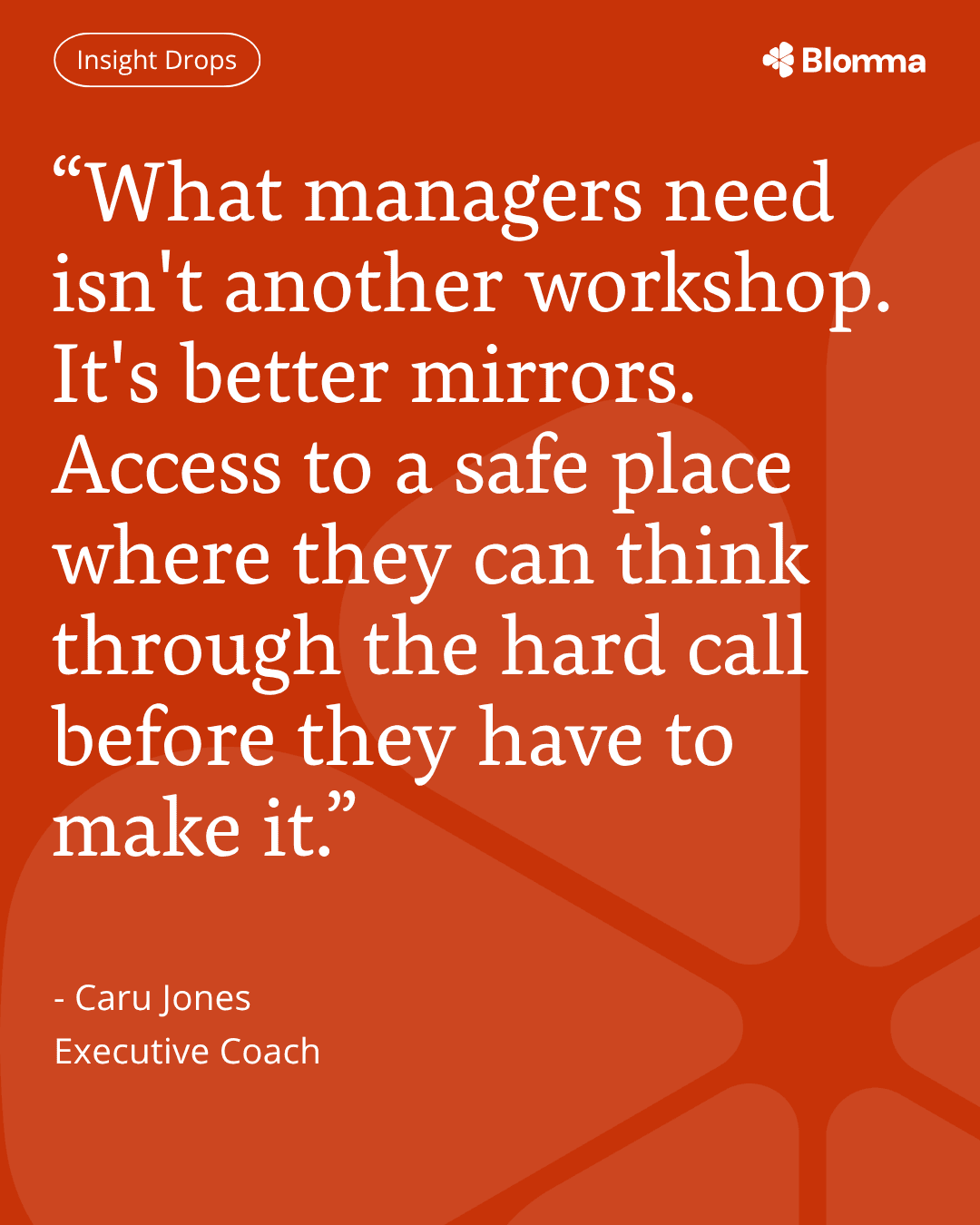
Caru Jones, Executive Coach, tells me: what managers need isn’t another workshop. It’s better mirrors. Access to a safe place where they can think through the hard call before they have to make it. Where they can rehearse a difficult conversation without performing confidence they don’t yet have. Where uncertainty is a resource, not a liability. This is part of the gap Blomma was built for: giving managers and professionals a private, responsive space to think before they have to act. We don’t see technology as a replacement for human judgment; it helps create better conditions for it.
🌻 Try Blomma free with code TRENDS
During the conference, I had the chance to ask a question to Meg Whitman and Anjali Sud: What do you think leaders should do right now? How should we change? Meg had a quick answer, “Immerse yourself in the technology and understand it deeply.” Anjali pointed to building trust. I agree with both.
The leaders I most respect right now have stopped pretending they have all the answers. They’ve become translators. Their job is not to eliminate uncertainty. It’s to help their people stand inside it without falling apart. That is both more human and more demanding than the role anyone originally designed.
What’s the one thing you wish you had more support with as a manager right now?
5. Craft Is Coming Back. And It Will Be Radical.
The contrarian take: The future of work is not more productivity. It is a rediscovery of what work is actually for.
For twenty years, the conversation about work has been dominated by output. Efficiency. Scale. Optimization. The elimination of friction. The promise that if we could just remove all the wasted time, all the manual steps, all the things that slowed us down, we would arrive somewhere better.
We are arriving. And some of us are starting to wonder: was this the destination we meant to reach?
Here’s what I keep sensing in the conversations that matter: beneath the AI anxiety, the layoff fatigue, the résumé cosplay, and the general exhaustion of performing ambition in public: a hunger for work that means something. A return to craft. I had a chance to connect with folks like Graham, founder of Yondr, or Sarah Robin, director of Your Attention Please, who are reminding us to pull our heads out of computers. At the same time, we had Boris Cherny on stage, creator of Claude Code - a huge revolution in how humans can bring ideas from their brains to the world. I think there’s craft in that as well.
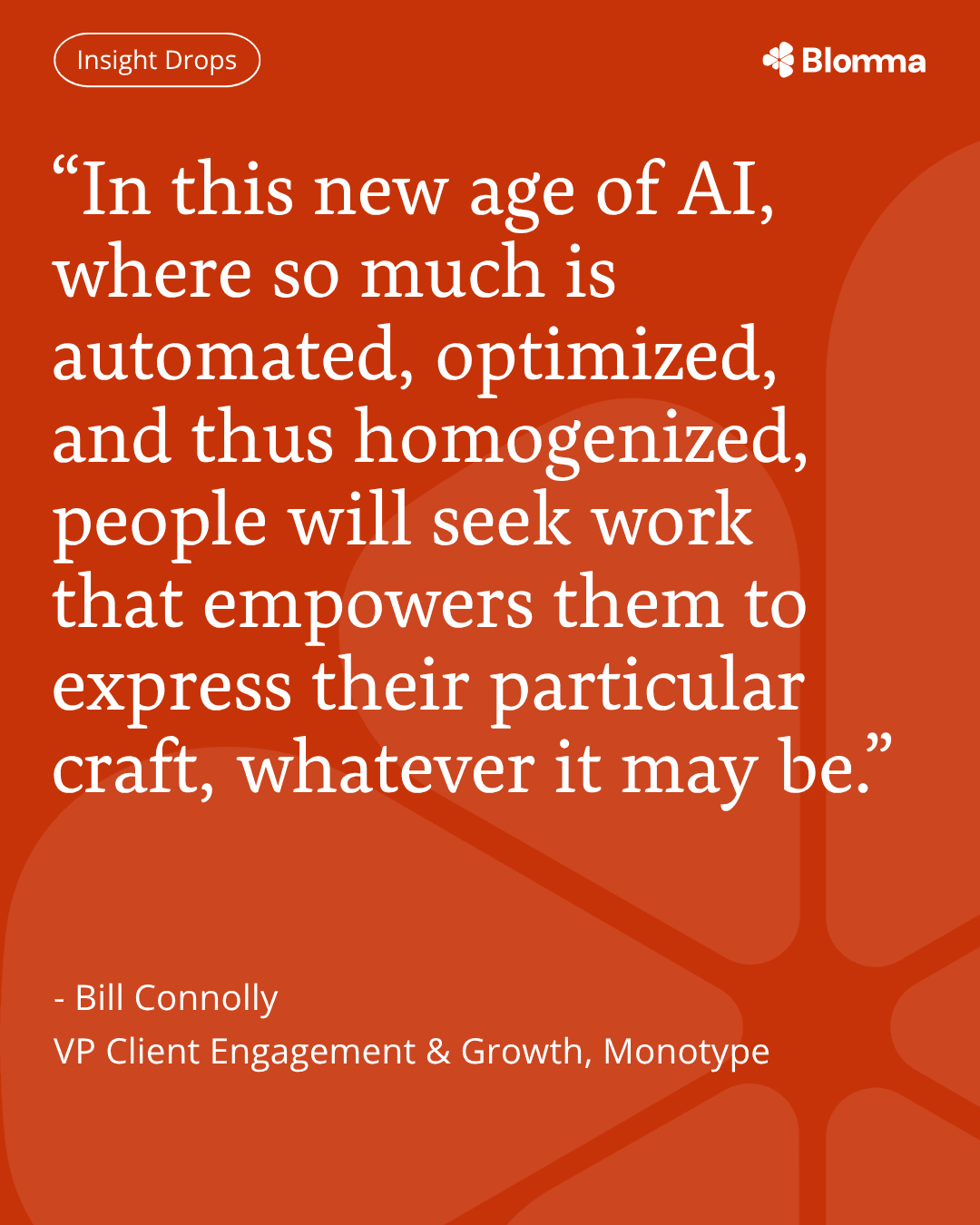
Bill Connolly was quick to respond when I asked him for his thoughts: Craft is a contagious phenomenon. It combines deep skill with the nuance of lived human experience. And in this new age of AI, where so much is automated, optimized, and thus homogenized, people will seek work that empowers them to express their particular craft, whatever it may be. In a way, it will be cool to care again - and we may be surprised at where it leads us. I agree, Bill. Caring is cool.
It’s also cool to have ability to make something distinctly yours. To build relationships that have texture and history and trust. To create things that carry your fingerprint, not just your output. I personally don’t think that the medium should define us.
AI is going to do a lot of the legible, reproducible work. What it cannot do, and what it will potentially make more valuable: is the irreducibly human part; the opinion and the taste. The creative leap that comes from having lived something. The sentence that lands because the person writing it has also bled a little.
We are at the beginning of a craft renaissance; a rediscovery of what humans bring that can’t be summarized in a benchmark.
The professionals who will flourish in the next decade are not the ones who become most like machines. They are the ones who become most fully, deliberately, unapologetically themselves.
What does craft look like in your work right now? Have you changed the way you work based on what you delegate to technology?
What Organizations Can Do Right Now
The patterns above are not inevitable. They’re a set of conditions; conditions that can be designed around.
Here’s what the organizations getting this right are actually doing:
1. Build the apprenticeship back deliberately. Stop assuming learning happens by proximity. Design it. Pair AI-assisted workflows with structured reflection, shadowing moments, and explicit feedback loops. The training ground doesn’t rebuild itself.
2. Redesign the interview, not just the job description. If you’re hiring for learning velocity, your process should test for it. Ask for examples of how candidates updated a belief, navigated ambiguity without a roadmap, or changed direction mid-project. Credentials tell you where someone has been. These questions tell you how they move.
3. Give managers somewhere to think. The manager squeeze is real, and it will not be fixed by a better framework deck. Create actual conditions for reflection — peer cohorts, structured thinking time, and tools that help managers prepare for hard conversations before they happen, not for after they’ve gone badly.
4. Audit your structures before your tools. Before the next AI vendor demo, ask: does our decision-making process allow new behavior to emerge? If every experiment requires six approvals and a quarterly review, the tool won’t save you. Structure is the variable.
5. Invest in the messy middle. The moments that most shape people’s growth, from a difficult feedback conversation, a confidence wobble, a career crossroads. The moments that happen outside official programs and scheduled 1:1s. Build support that’s available when people actually need it, not just when it’s convenient for the org chart.
This is the gap Blomma was built for: a private, responsive space where professionals and managers can think clearly before the big moment, not just debrief after it.
Need help navigating these trends?
Blomma is a private, responsive space to think clearly before the big career moments, not just debrief after them. Whether you’re navigating your own path or leading a team through this shift, there’s a door for you.
🌻 Try Blomma free with code TRENDS
If you’re building the kind of organization that takes people seriously, we’d love to talk.
→ Reach out to us if you want to learn more about how we can support your team: teams@mail.blomma.com
Silvia is co-founder of Blomma, a professional career coach powered by technology, accessible to all.